
Microservices Architecture: Modern Scalable Software Design
Microservices Architecture is a modern approach where applications are built using small independent services, making systems scalable, flexible, and easier to maintain.
Aman Singh·
3 min read·
195
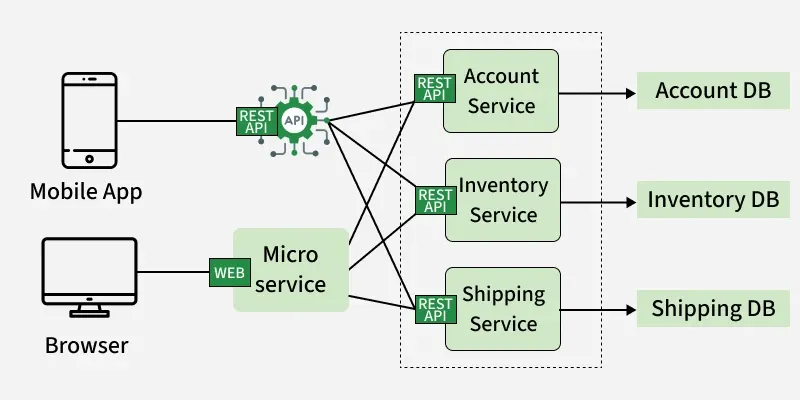
# **Microservices Architecture**
Microservices Architecture is a modern software design approach in which a large application is divided into multiple small, independent services.
Instead of building one huge application where everything is connected together, developers break the system into smaller services. Each service is responsible for a specific business function and communicates with other services when necessary.
For example, an e-commerce application might be divided into services such as:
* User Service
* Product Service
* Order Service
* Payment Service
* Notification Service
* Inventory Service
Each service has its own responsibility. The User Service manages user accounts, the Payment Service handles transactions, the Product Service manages product information, and the Notification Service sends emails, SMS messages, or push notifications.
One of the biggest advantages of microservices is **independent development and deployment**. A development team can update the Payment Service without having to rebuild and deploy the entire application. This allows different teams to work on different parts of the system at the same time.
Microservices also make it easier to scale applications. Suppose an online shopping platform receives millions of product searches but comparatively fewer payment requests. Instead of scaling the entire application, developers can increase the number of instances running the Product Service while leaving other services unchanged.
Another important benefit is **fault isolation**. If one service experiences a problem, the entire application does not necessarily have to stop working. For example, if the Notification Service goes down, users may still be able to browse products and place orders while notifications are temporarily unavailable.
Large technology companies such as Netflix, Amazon, Uber, and Spotify have used microservices-based approaches to support large and continuously evolving systems.
However, microservices are not automatically better than a traditional monolithic architecture. They also introduce additional complexity. Services need to communicate over networks, which can create latency and failure points. Developers must also manage service discovery, authentication, logging, monitoring, databases, deployments, and infrastructure across many different components.
**Advantages**
* Independent deployment
* Better scalability
* Faster development
* Easier fault isolation
* Flexible technology choices
* Smaller and more manageable codebases
**Disadvantages**
* Higher system complexity
* Network communication overhead
* Difficult debugging and monitoring
* More infrastructure to manage
* Requires strong DevOps practices
* Distributed data can be difficult to handle
Microservices Architecture is most useful for **large, complex applications** where different parts of the system need to scale and evolve independently. For a small application, however, microservices can add unnecessary complexity.
The goal of microservices is not simply to create more services. The real goal is to create a system where different parts can be developed, deployed, scaled, and maintained independently.
When implemented correctly, microservices can provide the flexibility and scalability required by modern applications while allowing development teams to move faster as the system grows.
Written by Aman Singh
Software Developer
Responses (1)
Log in to join the conversation
Sep 17
Informative