
Cognoras
ArticlesAboutFAQ
HomeAbout CognoraHelp & FAQ
Cognora

Practical, independent writing about artificial intelligence, software engineering, emerging technology, and the people building what comes next.

Explore

  • Latest articles
  • Featured articles
  • Write on Cognora

Company

  • About us
  • Contact
  • FAQ

Legal

  • Privacy policy
  • Terms of service
  • Cookie policy

Categories

  • AI & Agents
  • Developer Tools
  • Software Engineering
© 2026 Cognora. All rights reserved.

Cognora - AI, Technology, and Software Engineering Articles

·
·
·
·
·

Staff Picks

QuantumWorldQuantumWorld

A journey from the atomic structure of an NV center to initialization, microwave control, optical readout, ODMR, and eventually a physical quantum processor

CrimsonCrimson

Google AI Pro Free for Students: The One Offer That's Actually Live

CrimsonCrimson

Factory's $5B Round: What "Autonomous Coding" Actually Ships

Writing on Cognora

Share your knowledge — write articles about AI, tech, engineering, and more.

Knowledge for builders

Understand technology, then put it to work

Cognora is an open publishing community for useful perspectives on AI, software engineering, and emerging technology. Readers gain clear explanations, practical techniques, and informed viewpoints; authors gain a place to share tested ideas with curious professionals and learners.

Editor’s picks

Featured articles

Browse all

3 min read

Terminal Tricks That Made Me Faster as a Developer

I used the terminal like a basic command tool for years until I learned small workflow tricks that dramatically improved my speed, debugging, and productivity.

By Aman Singh

6 min read

AI Coding Agents Are Changing How Software Is Built in 2026

AI coding agents are transforming software development by handling multi-step tasks, testing, debugging, and repository-level work while developers increasingly focus on architecture, oversight, security, and strategic decisions.

By Aman Singh

7 min read

Will AI Replace Software Engineers in 2026? Here Is What the Data Actually Says

75% of Google's new code is now AI-generated. Entry-level hiring dropped 73%. But software developer jobs are still growing. Here is the honest answer.

By Aman Singh

Explore topics

Find focused writing in the areas that matter to you.

Quantumquantumcomputingnv diamondqpuqubitgoogle-ai-progeminifree-ai-tools

Latest articles

A journey from the atomic structure of an NV center to initialization, microwave control, optical readout, ODMR, and eventually a physical quantum processor

QuantumWorld · Sep 24, 2026

18 min read

Google AI Pro Free for Students: The One Offer That's Actually Live

Crimson · Sep 17, 2026

5 min read

Factory's $5B Round: What "Autonomous Coding" Actually Ships

Crimson · Sep 17, 2026

4 min read

What does manual batch record review really cost pharmaceutical manufacturers?

Saxon AI · Sep 10, 2026

4 min read

Why readers trust Cognora

Real authors

Every story shows its author, publication date, and reading time so you can assess its context.

Useful over noisy

We prioritize original explanations and practical experience over repetitive, search-first publishing.

Transparent platform

Our mission, policies, and contact details are easy to find and understand.

Good to know

Frequently asked questions

View the complete FAQ

What is Cognora?

An open publishing community for practical insight about AI, software engineering, and emerging technology.

Do I need an account to read?

No. Published articles are public. Accounts unlock writing, following, commenting, and story management.

Can I contribute an article?

Yes. Sign in and use the writing tools to turn useful experience into a clear story for the community.

Have something worth sharing?

Turn your experience into a clear, useful article for the Cognora community.

Start writing
QuantumWorldQuantumWorld·Sep 24

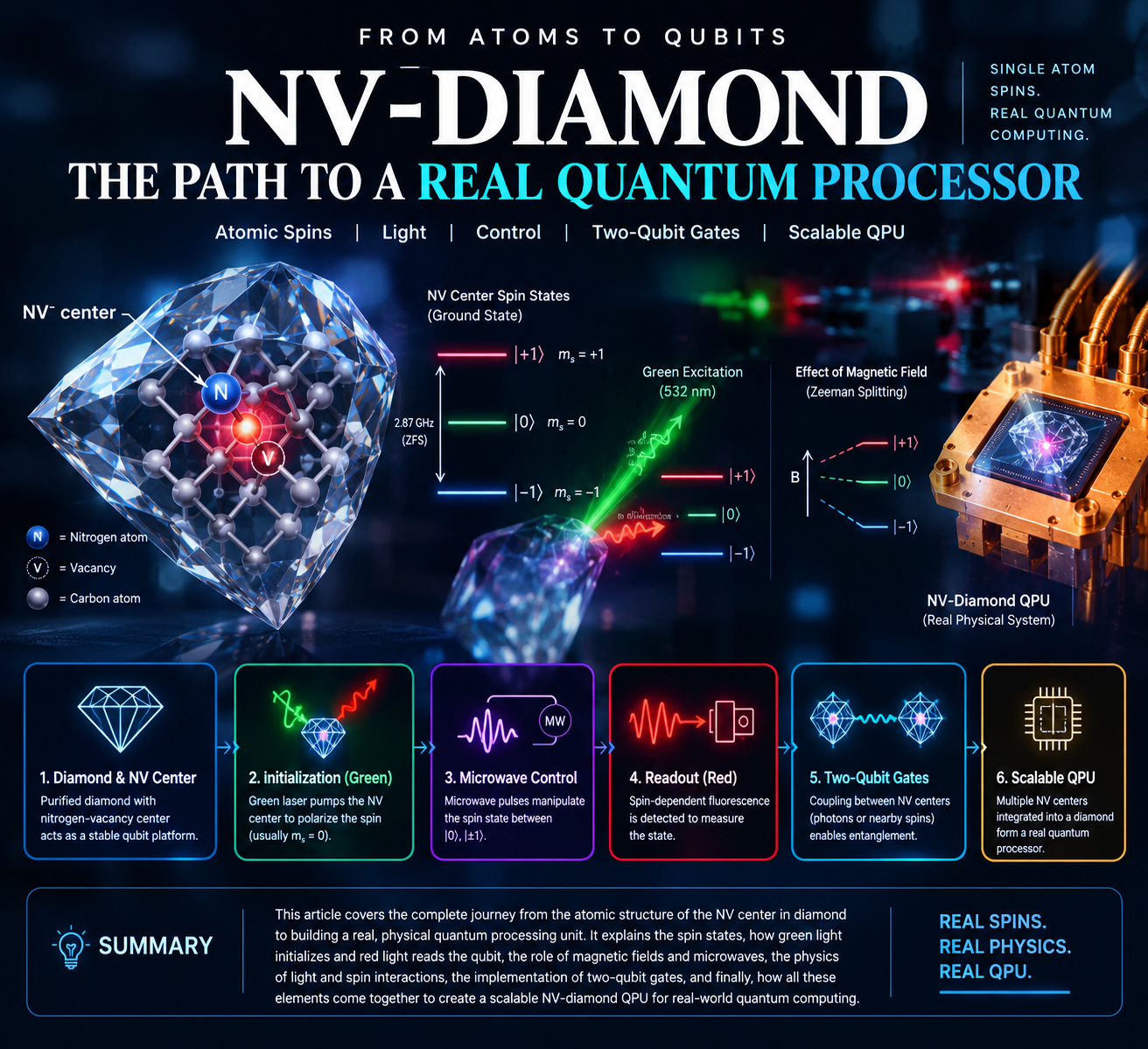
A journey from the atomic structure of an NV center to initialization, microwave control, optical readout, ODMR, and eventually a physical quantum processor

A negatively charged nitrogen-vacancy (NV⁻) center in diamond is a remarkably controllable quantum system. Its electron spin can be initialized with green light, manipulated with microwave radiation, and measured through spin-dependent red fluorescence. These properties make NV centers useful for quantum sensing, quantum information processing, and quantum-network research. A practical path toward an NV-based QPU therefore begins not with a complicated multi-qubit machine, but with a single physical phenomenon: detecting and controlling one or more NV spins with light and microwaves

18 min readQuantum0044
A journey from the atomic structure of an NV center to initialization, microwave control, optical readout, ODMR, and eventually a physical quantum processor